Get in touch
I'm always excited to take on new projects and collaborate with innovative minds.
Phone
Website
Address
Dhaka, bangladesh
I'm always excited to take on new projects and collaborate with innovative minds.
Dhaka, bangladesh

More and more people are asking their phones and smart speakers for answers instead of typing a query into a search box. "Where is the nearest CCTV shop open now?" "What is the best router for a small office?" These spoken questions are changing how search works, and in my work as an SEO professional I have seen the shift first-hand: the queries that bring people to a website are becoming longer, more conversational and far more local. If your website is not ready for that, you are missing visitors who are ready to act.
Voice search optimisation is not a separate kind of SEO. It is the same good practice — clear content, fast pages and trustworthy information — applied to the way people actually speak. Here is how to do it.
When someone types, they use shorthand: "CCTV camera price Dhaka". When they speak, they use full sentences: "How much does a CCTV camera cost in Dhaka?" That difference changes which pages get found.
Spoken searches usually run to five or more words and sound like a question you would ask a person. Your content should answer in the same natural language, not in keyword-stuffed fragments.
Who, what, where, when, why and how dominate voice search. Pages that directly answer a specific question have a much better chance of being read aloud as the answer.
A large share of voice searches are about something nearby — opening hours, directions, a phone number. For a local business, this is the biggest opportunity voice search offers.
Before writing anything, collect real questions. Look at the questions customers ask you by phone, on WhatsApp and in your shop. Check the "People also ask" box on Google for your main topics, and read the search queries in Google Search Console to see the question-style phrases your site already appears for.
Then give each important question its own clear answer on your site. A short FAQ section on a service or product page is one of the simplest ways to do this. Keep each answer focused on one question, and put the direct answer in the first sentence before adding detail.
Voice assistants read answers aloud, so your writing needs to sound natural when spoken. Read your answer out loud: if it sounds stiff or robotic, rewrite it the way you would explain it to a customer face to face.
A practical pattern that works well is to answer the question in one or two short sentences first, then expand with the detail underneath. This also helps your page win the featured snippet — the boxed answer at the top of Google results — which is where voice assistants usually take their answer from.
For example, a page about CCTV installation could open its FAQ with: "A basic four-camera CCTV system for a small shop usually takes one working day to install, including wiring and setup." That is the kind of direct answer a voice assistant can use.
Almost all voice searches happen on a phone or a smart speaker, so speed and mobile usability matter more than ever. A page that takes too long to load will not be chosen as an answer, however good its content is.
Check your pages with Google's PageSpeed Insights and fix the biggest issues first — usually oversized images and unnecessary scripts. If you need a refresher, my guide on how to speed up a slow website walks through the practical steps. Also confirm your site is genuinely easy to use on a small screen: readable text, tappable buttons and no horizontal scrolling.
When someone asks "where can I buy a Wi-Fi camera near me", the assistant looks at local listings before anything else. Make sure your Google Business Profile is complete and accurate — correct address, phone number, opening hours and business category — and keep the same details consistent on your website and everywhere else your business appears online.
My guide to setting up a Google Business Profile covers this in detail. Reviews help too: a steady flow of genuine customer reviews makes your listing more likely to be recommended.
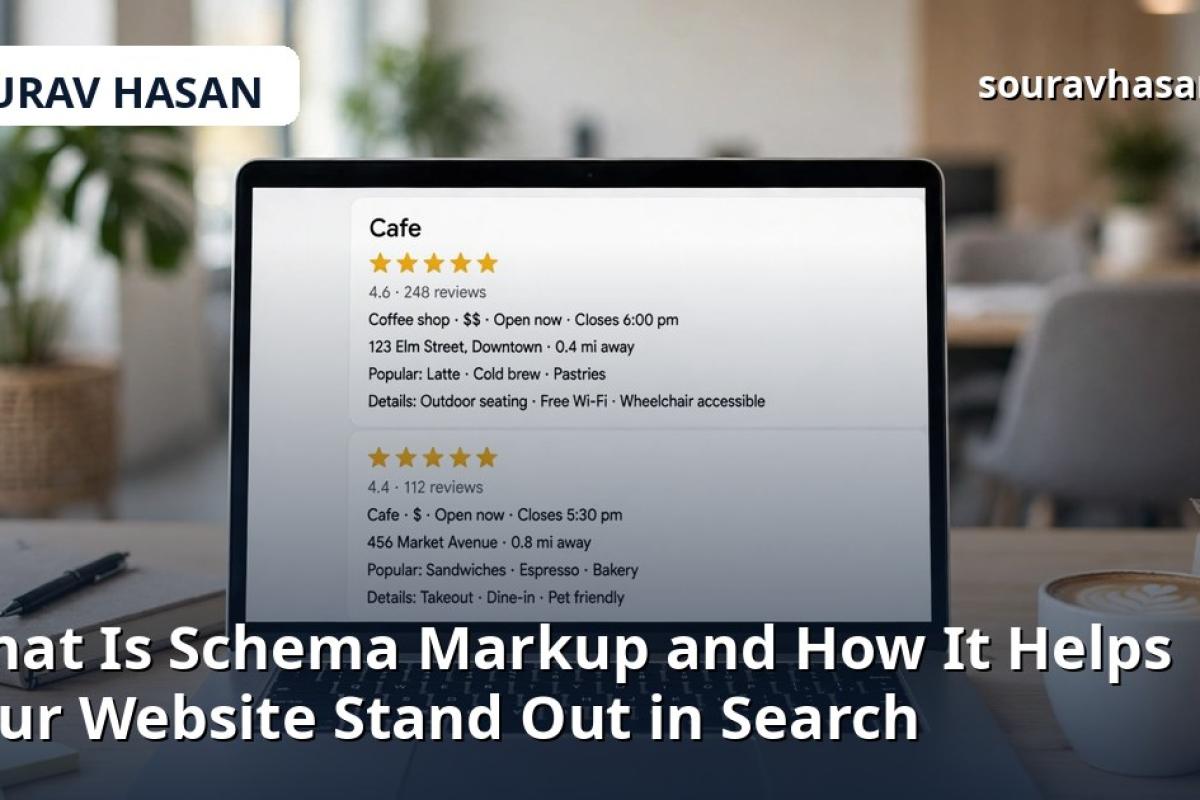
Structured data (schema markup) is a way of labelling information on your page so search engines understand it — your business address, opening hours, product prices, FAQs and more. It does not guarantee a voice answer, but it makes it easier for a search engine to pick your page as one. If you are new to this, my introduction to schema markup explains the basics and where to start.
Voice search has no separate report in Google Search Console, but you can watch for the signs: question-style queries appearing in your search results, more impressions on FAQ pages, and more "near me" searches. Review these monthly and add answers for any new question that keeps appearing. Optimisation for voice search is a habit, not a one-time task.
No. Voice search rewards the same things as regular SEO: clear answers, fast mobile-friendly pages and accurate local information. Treat it as an extension of your existing SEO work, not a separate project.
Short, direct answers to specific questions work best, followed by supporting detail. FAQ sections, how-to guides and service pages written in plain language tend to perform well.
The spoken answer is usually short — one or two sentences. That is why it helps to put the direct answer first and the detail after it, so both the voice assistant and the reader get what they need.
Yes, arguably more than for anyone else. Many voice searches have local intent — finding a shop, checking hours, getting directions — so a well-optimised local listing can bring customers through the door the same day.
Voice search is not a trend to chase and forget; it is simply how more of your customers are searching now. Start with their real questions, answer them clearly and honestly, keep your pages fast and your local details accurate, and your website will be ready whenever someone asks their phone for exactly what you offer.
Your email address will not be published. Required fields are marked *