Get in touch
I'm always excited to take on new projects and collaborate with innovative minds.
Phone
Website
Address
Dhaka, bangladesh
I'm always excited to take on new projects and collaborate with innovative minds.
Dhaka, bangladesh
Should a small business use an AI chatbot, human support, or both? A practical look at what chatbots do well, where humans win, and how to combine them.
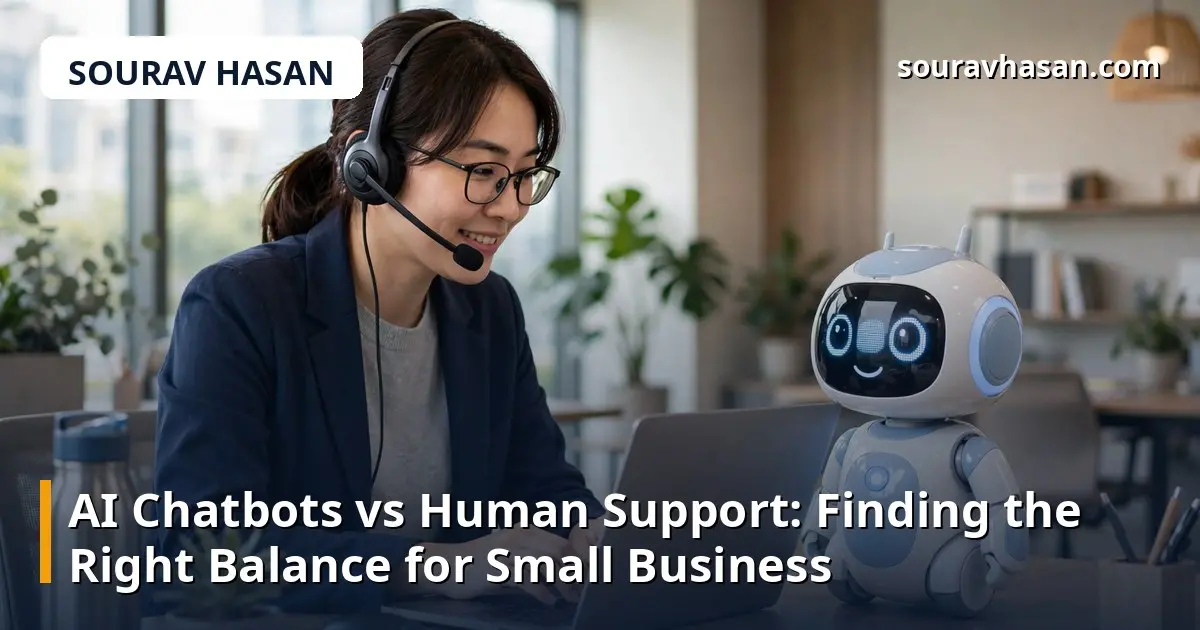
Every small business owner has felt it: the same questions arriving again and again — opening hours, delivery times, prices, stock. An AI chatbot promises to answer them all, instantly, at any hour. Human support promises something else: a person who actually understands the problem. The honest answer for most small businesses is not one or the other. It is both, used for the right jobs.
Chatbots are at their best with questions that are simple, repeated and factual. "What time do you close?", "Do you deliver to my area?", "Is this product in stock?" — these are questions a chatbot can answer in seconds, at midnight, without getting tired or annoyed. For a small business, that matters: customers message at all hours, and a fast answer can be the difference between a sale and a lost visitor.
Chatbots also help with triage. A good chatbot collects the basics — order number, product name, the nature of the problem — before a human ever gets involved. That means when a person does step in, they start with context instead of spending the first five minutes asking for it.
And chatbots are consistent. They never forget the delivery policy, never give a different price to different customers, and never have a bad day. For routine information, consistency is a genuine advantage.
But chatbots have clear limits. They struggle with anything unusual, emotional or complicated: a damaged delivery, a refund request, a customer who is upset, a problem that does not fit the script. In those moments, a customer does not want a faster automated reply — they want someone who listens, takes responsibility and solves the problem.
Humans also win at selling and advising. A chatbot can list product features; a person can ask what the customer actually needs and recommend the right option, including telling them when the cheaper product is the better choice. That kind of honest advice builds the trust that brings customers back. No chatbot I have used earns loyalty the way a good human conversation does.
There is also a simple psychological point: when something has gone wrong, being passed around by a bot feels like the business does not care. A human voice — or even a human-written message — signals that someone is taking the problem seriously.
Here is a setup that works well for most small businesses, including the store I run:
If you decide to add a chatbot, a few rules keep it helpful rather than irritating. First, keep the scope narrow: train it on your real FAQs, not on everything. A bot that answers ten questions correctly is more useful than one that guesses at fifty.
Second, be transparent. Never design a bot to pretend it is human. Customers who discover they have been talking to a machine feel misled, and that feeling lasts longer than the conversation.
Third, review the conversations regularly. Read what customers actually asked and where the bot failed. Those failed conversations are your best guide to what to fix — both in the bot and in your website, since a question the bot could not answer is often a question your product pages should have answered already.
Finally, keep the tools simple. Many small businesses already use the messaging tools built into their website platform or social pages. You do not need an expensive system to start; you need a bot that answers the questions you actually get. I have written before about AI tools that speed up everyday IT and SEO work, and the same principle applies here: start with one tool, use it well, and add more only when there is a clear reason.
For most small businesses, no. Chatbots handle routine questions well, but complaints, complex problems and advice still need a person. A business that removes humans entirely usually pays for it in lost trust.
Basic chatbots are often included in website platforms or messaging tools at little or no extra cost. More advanced AI chatbots charge a monthly fee. Start with the simplest option that covers your FAQs and upgrade only if the volume justifies it.
Most customers are fine with a bot for quick, factual questions, as long as they can reach a human easily when they need one. What frustrates people is a bot that blocks the way to a person.
Refunds, complaints, anything involving a payment dispute, and any situation where the customer is clearly upset. Those should go to a human as quickly as possible.
A chatbot is a tool, not a replacement for caring about customers. Use it to answer the questions you have answered a hundred times, and save your human time for the conversations where a person genuinely makes the difference. That balance — fast automation where it helps, real people where it matters — is what good small-business support looks like.
Your email address will not be published. Required fields are marked *